
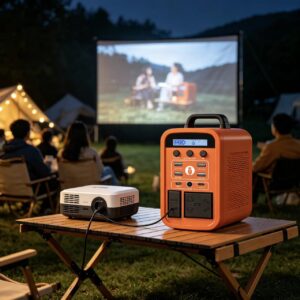
A portable power station can keep your television running during a blackout, while camping, in a home office, or anywhere reliable mains electricity is unavailable. But how long can a portable power station run a TV? The answer depends mainly on the power station’s battery capacity, your TV’s actual power consumption, inverter efficiency, and what other devices are connected at the same time.
A small 500Wh portable power station may run an energy-efficient TV for several hours, while a 1,000Wh or 3,000Wh power station can provide substantially longer runtime. However, the advertised battery capacity is not the same as the amount of energy that ultimately reaches the TV.
Understanding the calculation helps you choose the right portable power station for TV use, avoid unexpectedly short runtimes, and determine whether a power station can keep your TV operating throughout an evening or even overnight.
How Long Will a Portable Power Station Run a TV?
Before looking at individual battery sizes, it is important to understand why there is no single answer to how long a power station will run a TV.
Televisions have different power requirements. A compact LED TV may consume considerably less electricity than a large-screen television operating at high brightness.
For practical planning, an efficient modern TV might consume roughly 40–100 watts while operating, although actual consumption varies significantly by model and settings.
For example, if a TV consumes 60W:
– A 500Wh power station could provide several hours of operation.
– A 1,000Wh power station could provide roughly a full evening of viewing.
– A 2,000Wh power station could provide substantially longer operation.
– A 3,000Wh power station can provide many hours of TV viewing and still have capacity available for other essential electronics.
These are estimates rather than guarantees because power stations lose some energy through the inverter and other internal components.
What Determines Portable Power Station TV Runtime?
The battery capacity printed on a power station is only the starting point. Several technical factors determine the actual portable power station TV runtime.
1. Battery Capacity
Battery capacity is normally expressed in watt-hours (Wh). This is one of the most important specifications when choosing a portable power station.
A 1,000Wh battery theoretically stores twice as much energy as a 500Wh battery. Similarly, a 3,000Wh system stores approximately three times the energy of a 1,000Wh system.
However, you should not assume that 1,000Wh means exactly 1,000Wh will reach an appliance connected through AC power.
2. TV Power Consumption
The second major factor is the TV’s wattage.
A TV rated at 50W places a much smaller load on a battery than one consuming 120W. Screen size, brightness, HDR operation, sound volume, display technology, and other operating conditions can affect consumption.
For the most accurate calculation, check the TV’s specification label or manufacturer’s manual. If the TV says it consumes 80W, use 80W in your calculation rather than relying on a generic estimate.
3. Inverter Efficiency
When you connect a normal AC television to a portable power station, the battery’s DC electricity has to be converted into AC electricity by the inverter.
That conversion is not 100% efficient. Some stored energy is consumed by the power station itself and lost as heat during the conversion process.
This is why a technician should calculate usable energy, rather than simply dividing the advertised battery capacity by the TV’s wattage.
A practical planning estimate is to allow for approximately 10–20% conversion and system losses when using AC power, although the actual figure depends on the power station, load, and operating conditions.
4. Other Devices Connected to the Power Station
Your TV may not be the only device consuming electricity.
If you simultaneously operate a Wi-Fi router, decoder, soundbar, gaming console, laptop, or LED lights, their combined consumption reduces the available runtime.
For example:
TV: 60W
Wi-Fi router: 10W
Decoder: 15W
Soundbar: 20W
Total load: 105W
A power station that could run the TV alone for many hours will discharge considerably faster with a 105W combined load.
How to Calculate Portable Power Station Runtime
The simplest practical formula is:
Runtime (hours) ≈ Battery Capacity (Wh) × Efficiency ÷ Appliance Power (W)
For a conservative estimate, an efficiency factor of 0.85 can be used for an AC-powered appliance:
Runtime ≈ Wh × 0.85 ÷ TV watts
For example, suppose you have a 1,000Wh portable power station, and your television consumes 60W.
1,000Wh × 0.85 ÷ 60W = approximately 14.2 hours
This does not mean every 1,000Wh power station will run every 60W TV for exactly 14.2 hours. Real-world runtime can differ because of inverter efficiency, battery management, no-load consumption, and the TV’s changing power demand.
Nevertheless, this calculation provides a useful starting point when comparing portable power stations for TV backup.
How Long Can a 500Wh Power Station Run a TV?
A 500Wh power station is a popular size for portable electronics, camping, and basic emergency backup.
Assuming an effective usable energy figure of approximately 85%:
500Wh × 0.85 = 425Wh usable energy
If your TV consumes 50W:
425 ÷ 50 = approximately 8.5 hours
At 60W:
425 ÷ 60 = approximately 7.1 hours
At 100W:
425 ÷ 100 = approximately 4.25 hours
Therefore, a 500Wh portable power station can potentially provide several hours of television viewing, depending on the TV’s actual consumption.
For example, the BLUETTI AC50P has a 504Wh LiFePO₄ battery and a 700W pure sine wave inverter, making this class of power station suitable for relatively modest electronic loads such as TVs and networking equipment.
How Long Can a 1,000Wh Power Station Run a TV?
A 1,000Wh power station approximately doubles the stored energy of a 500Wh model.
Using the same 85% planning efficiency:
1,000Wh × 0.85 = 850Wh usable energy
For a 60W TV:
850 ÷ 60 = approximately 14.2 hours
For an 80W TV:
850 ÷ 80 = approximately 10.6 hours
For a 100W TV:
850 ÷ 100 = approximately 8.5 hours
This makes a 1,000Wh portable power station a strong option for households wanting several hours of TV entertainment during a blackout while also supporting smaller electronics.
How Long Can a 2,000Wh Power Station Run a TV?
A 2,000Wh power station provides significantly more energy storage.
At an assumed 85% usable efficiency:
2,000Wh × 0.85 = 1,700Wh
A 60W TV could theoretically run for:
1,700 ÷ 60 = approximately 28.3 hours
An 80W TV could run for:
1,700 ÷ 80 = approximately 21.3 hours
However, running a TV continuously for these durations is only a theoretical calculation. In a real home, other equipment, inverter consumption, and variations in TV power demand will reduce the actual runtime.
How Long Can a 3,000Wh Power Station Run a TV?
A 3,000Wh-class power station is designed for substantially larger energy requirements and extended backup.
Using the same conservative 85% planning assumption:
3,000Wh × 0.85 = 2,550Wh
A 60W TV would theoretically run for:
2,550 ÷ 60 = approximately 42.5 hours
At 100W:
2,550 ÷ 100 = approximately 25.5 hours
A real-world setup will produce different results, particularly if the power station is simultaneously powering a refrigerator, router, lights, laptops, or other household appliances.
A good example is the BLUETTI Home Star 3, which has a 3014.4Wh (3.0kWh) LiFePO₄ battery and a 2000W pure sine wave output. Its capacity makes it suitable for much more than television backup, including household electronics and other compatible essential loads.
Can a Portable Power Station Run a Smart TV?
Yes. A portable power station can run a Smart TV as long as the power station’s AC output is compatible with the television’s requirements.
The important specifications are continuous AC output, battery capacity, and inverter type.
Most televisions have relatively modest running-power requirements compared with high-power household appliances. Nevertheless, always check the TV’s input rating and the power station’s output specifications before connecting it.
A pure sine wave inverter is particularly desirable for sensitive electronic equipment because it provides a clean AC waveform suitable for modern electronics.
The TV itself may also consume additional electricity when connected to networking equipment, streaming devices, or sound systems.
Can a Portable Power Station Run a TV Overnight?
In many cases, yes—but whether it can do so depends on the TV’s wattage and the power station’s capacity.
Suppose a TV consumes 60W and you want to watch it for eight hours:
60W × 8 hours = 480Wh
That means the television alone requires approximately 480Wh of energy before accounting for conversion losses.
A 500Wh power station may therefore be marginal for an eight-hour session, while a larger battery provides a more comfortable reserve.
This illustrates an important technician’s rule: do not size a power station exactly to the appliance’s calculated energy requirement. Build in a reasonable reserve.
What Size Portable Power Station Do I Need for a TV?
Choosing the right power station starts with measuring the TV’s actual consumption and deciding how long you need it to operate.
For occasional blackout protection and a modest TV, a 500Wh portable power station may be sufficient.
For longer evening viewing or simultaneous use of a TV, Wi-Fi router, and decoder, consider 1,000Wh or more.
For extended home backup and multiple appliances, a 2,000Wh–3,000Wh system offers substantially more energy storage.
The power rating is also important. A power station must have enough continuous AC output to handle the connected load. Battery capacity determines how long the equipment runs, while inverter output determines what the power station can safely power at the same time.
How to Maximize TV Runtime on a Portable Power Station
Once you have the correct power station, a few practical measures can extend operating time.
Reduce TV Brightness
High brightness settings can increase electricity consumption. Using a comfortable but moderate brightness level can help conserve battery energy.
Turn Off Unnecessary Equipment
Disconnect devices that are not needed. A soundbar, gaming console, decoder, and additional streaming equipment can collectively consume more power than expected.
Use Energy-Efficient TVs
Energy efficiency matters because every watt saved extends battery runtime. Certified televisions are, on average, substantially more energy efficient than conventional models.
Monitor Your Actual Load
If the power station has a display or mobile application showing real-time wattage, use it. Measuring actual consumption is more accurate than relying solely on the TV’s nominal rating.
Portable Power Station vs Generator for TV Backup
For television backup, a portable power station has several practical advantages over a conventional fuel generator.
A battery power station operates quietly and produces no exhaust fumes at the point of use. It is therefore particularly convenient for indoor electronics when used according to the manufacturer’s safety instructions.
It can also be recharged from mains electricity or, depending on the model, solar panels. This makes a solar-compatible portable power station particularly useful where electricity interruptions are frequent.
A fuel generator, on the other hand, can provide extended energy as long as fuel is available and is generally better suited to sustained high-power loads. The right choice depends on the appliances you need to power, required runtime, noise tolerance, and available charging options.
Final Verdict: How Long Can a Portable Power Station Run a TV?
So, how long can a portable power station run a TV?
There is no universal runtime because every television and power station combination is different. As a practical guide, an energy-efficient 60W TV could potentially run for around 7 hours from a 500Wh power station, 14 hours from a 1,000Wh unit, 28 hours from a 2,000Wh unit, or more than 40 hours from a 3,000Wh unit, using an approximate 85% usable-energy assumption.
Actual runtime will vary according to inverter efficiency, TV power consumption, brightness, battery condition, connected devices, and other operating factors.
The most reliable approach is to check your TV’s actual wattage, calculate the required watt-hours, account for conversion losses, and then select a power station with additional capacity rather than operating at the absolute limit.
Need a Reliable Portable Power Station in Kenya?
If you are looking for dependable portable power stations in Kenya, MK Homestyles offers power backup solutions for households, offices, entertainment systems, and essential electronics.
From compact 500Wh portable power stations for TV and Wi-Fi backup to high-capacity 3kWh home energy storage systems, choosing the right battery capacity can make the difference between a short emergency backup and dependable power throughout an outage.
For customers searching for a portable power station in Kenya, portable power station price in Kenya, home backup power Kenya, LiFePO₄ power stations, solar-compatible power stations, or reliable blackout power backup, MK Homestyles can help you choose a system based on your actual power requirements.
Explore MK Homestyles portable power stations and choose reliable backup power designed to keep your essential electronics running when the grid goes down.