
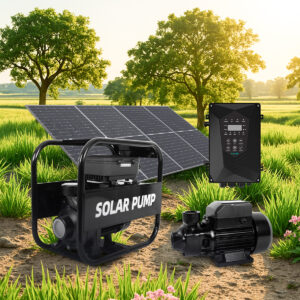
A common question from homeowners, farmers and property owners considering solar water pumping is: how many hours a day can a solar water pump run? The answer is not simply “as long as the sun is shining.” A properly designed solar water pumping system can operate for several hours each day. Still, its actual running hours depend on available sunlight, solar panel capacity, pump size, water demand, pumping head, flow rate, weather, and whether the system includes battery storage.
In practical terms, many direct-solar pumping systems are designed to operate primarily during daylight hours, while systems equipped with suitable energy storage or alternative power sources can extend pumping beyond the available solar hours. The Food and Agriculture Organization (FAO) notes that solar pumping performance is strongly affected by location, season and weather, making proper system sizing essential.
Understanding these factors is important because buying a powerful pump without matching it to the solar array and water requirement can result in disappointing water output.
How Many Hours Can a Solar Water Pump Run Per Day?
The number of hours a solar water pump can run per day depends primarily on the amount of usable solar energy available and on how the system is designed.
A basic solar water pumping system without batteries generally operates when sufficient solar power is available. As sunlight becomes stronger in the morning, the pump can start operating or increase its output. Around the strongest solar period, the pump may approach its rated performance. As sunlight decreases later in the afternoon, its output can reduce.
This means that a pump may technically operate over a relatively long daylight period while producing different amounts of water at different times.
The FAO explains that solar radiation varies with location, time of year, and weather, and that this variability directly affects solar pumping performance.
Therefore, asking “How many hours does a solar pump work?” without considering the solar resource can produce a misleading answer.
Does a Solar Water Pump Run Only When the Sun Is Out?
To understand solar pump operating hours, it is important to distinguish between a direct solar water pump and a system with energy storage.
A direct solar pumping system obtains electricity from photovoltaic panels. When sunlight is available, the panels generate electricity that powers the pump. When sunlight becomes insufficient, the pump’s output will normally reduce and eventually stop.
This does not necessarily mean the pump runs at the same power from sunrise to sunset. Solar irradiance changes throughout the day, so the pump’s speed and water output can change accordingly.
For irrigation and water supply applications, technicians often design the system around daily water volume rather than simply specifying a desired number of operating hours. Solar water pumping experts recommend determining daily water demand and available solar irradiation when sizing the system.
What Determines Solar Water Pump Running Hours?
Several technical factors determine the daily runtime of a solar water pump. Looking at all of them together gives you a much more accurate understanding of how long your pump can operate.
1. Available Sunlight
Solar radiation is the foundation of a photovoltaic pumping system. More usable sunlight generally means more energy available to operate the pump.
However, “hours of daylight” and peak sun hours are not the same thing.
A day can have many hours of daylight, but only a smaller number of hours when solar irradiance is strong enough to deliver the equivalent of full-rated solar production.
This distinction is critical when calculating the performance of solar water pumps.
Clouds, shade, dust, seasonal changes and the orientation of the solar panels can all reduce available energy.
2. Solar Panel Capacity
The solar array must be appropriately matched to the pump.
For example, installing a pump that requires substantially more electrical power than the solar panels can provide will result in poor performance. The pump may operate slowly, fail to reach its expected flow rate or stop when sunlight falls.
Conversely, a properly sized solar array can provide enough energy for the pump to deliver the required amount of water during the available solar resource.
This is why solar water pump sizing should consider the complete system rather than simply matching the pump’s horsepower to an arbitrary number of solar panels.
3. Pump Power and Efficiency
The solar water pump itself has a major effect on operating time and water production.
A high-power pump can move substantial volumes of water, but it also requires more electrical energy. A smaller pump may consume less energy but could take longer to deliver the same quantity of water.
This creates an important distinction:
Pump runtime is not the same as water delivered.
For example, a pump delivering 5,000 litres per hour for four hours produces approximately 20,000 litres under the stated operating conditions. A pump delivering 2,500 litres per hour would need approximately eight hours to move the same volume.
Actual performance depends on the pump’s operating point, system head and other losses, so manufacturer pump curves should be used rather than relying solely on advertised maximum flow.
4. Pumping Head
One of the most frequently overlooked factors when installing a solar water pump is the total head.
Head refers broadly to the resistance the pump must overcome to move water from the source to the delivery point. It includes elevation as well as losses through pipes, fittings and other components.
A pump moving water a short vertical distance will generally have a different operating point from the same pump lifting water from a deep borehole to an elevated storage tank.
Total water requirement, desired flow rate, source flow, vertical lift and total head are important considerations when selecting a pump.
This is why two installations using the same solar pump can produce very different results.
5. Water Demand
The required water volume should be determined before determining how long the pump needs to run.
A household may need a relatively modest quantity of water each day, while a farm may require significantly more for irrigation or livestock.
Modern solar pumping design, therefore, focuses on questions such as:
- How many litres of water are required per day?
- What is the water source?
- How deep is the water?
- How high must the water be lifted?
- What flow rate is required?
- How much sunlight is available?
- What happens during periods of reduced sunlight?
The Food and Agriculture Organisation of the United States (FAO) and other solar-pumping design resources emphasise daily water demand, discharge, head losses, and pump selection as key elements of system sizing.
Can a Solar Water Pump Run All Day?
A solar pump can operate for much of the daylight period if the system is appropriately sized, but this does not mean it will necessarily deliver its maximum rated flow throughout that period.
Early in the morning, available solar power may be insufficient for full output. Production normally increases as solar irradiance rises, peaks around midday, and then decreases later in the afternoon.
Consequently, a technician should be careful when telling a customer that a pump “runs for eight hours.”
The more useful question is:
How much water will the system deliver during the entire day under the expected solar conditions?
That figure provides a much better basis for system design.
Can a Solar Water Pump Run at Night?
A conventional direct-solar water pump cannot normally continue pumping at night because photovoltaic panels require sunlight to generate electricity.
However, there are several ways to provide water after sunset.
Battery Storage
A battery can store electrical energy generated during the day and provide power to the pump later. This can extend the solar pump operating hours, although the battery adds cost, complexity and additional system losses.
Elevated Water Storage
For many applications, storing water rather than electricity can be a practical approach.
The solar pump operates when sunlight is available, pumping water into a storage tank. Water can then be used later in the evening or overnight without requiring the pump to operate.
Water-pumping experts recommend elevated reservoirs to separate the timing of pumping from the timing of water use.
For many installations, this approach can be technically simpler than using batteries solely to operate the pump at night.
Does a Solar Pump Work on Cloudy Days?
A solar water pump can still receive some solar energy on cloudy days, but its output may decrease significantly depending on the cloud cover’s thickness.
Solar panels do not require clear skies to generate electricity. However, reduced solar irradiance means less power is available to the pump.
The result can be lower flow, slower pumping or shorter effective operating periods.
This is why professional solar water pump sizing should account for seasonal and weather-related variations rather than relying solely on ideal sunny-day performance, considering solar irradiation and critical periods when designing photovoltaic pumping systems.
How Long Does It Take a Solar Pump to Fill a Water Tank?
Once you know the pump’s actual flow rate, calculating approximate filling time becomes straightforward.
For example, suppose a pump delivers 4,000 litres per hour under the installation’s actual operating conditions.
A 10,000-litre tank would theoretically require:
10,000 ÷ 4,000 = 2.5 hours
However, this is an idealized calculation. Real installations can experience variations in solar power, water level, head, pipe losses and pump performance.
Therefore, don’t size a system based solely on the pump’s advertised maximum flow. The flow rate at the required head is much more useful.
How to Increase Solar Water Pump Operating Hours
If your existing system does not provide enough daily water, the solution is not automatically to install a larger pump.
A qualified technician should first determine where the limitation occurs.
Possible improvements include:
- Increasing solar panel capacity where appropriate
- Cleaning dusty solar panels
- Removing shading from the array
- Correcting panel orientation and installation
- Checking cable sizing and electrical connections
- Selecting a pump appropriate for the required head
- Reducing unnecessary pipe restrictions
- Using a correctly sized storage tank
- Adding battery storage where night-time pumping is genuinely required
- Reassessing the daily water requirement
A recent Food and Agricultural Organization of the United Nations indexed solar pumping sizing study similarly highlights the importance of considering solar irradiance, temperature and required system capacity when determining the appropriate photovoltaic system size.
Should You Buy a Bigger Solar Pump?
A bigger pump is not automatically a better pump.
This is a common mistake in many solar pumping projects: selecting a high-horsepower pump first and attempting to build the solar system around it afterwards.
The correct approach is to start with the water requirement, determine the required flow and total dynamic head, assess the available solar resource, and then select a pump and PV array that work together.
For irrigation, drinking water, and livestock applications, system sizing should also account for the period when water demand and solar availability are least favourable. FAO recommends sizing irrigation systems around the relevant “critical month” rather than relying solely on average annual conditions.
Final Answer: How Many Hours a Day Can a Solar Water Pump Run?
So, how many hours a day can a solar water pump run?
There is no universal number of hours that applies to every solar water pump.
A direct solar system generally operates during periods when sufficient solar energy is available, with its output changing throughout the day. A correctly designed system may provide several hours of useful pumping each day, while systems incorporating batteries or other power sources can extend operation beyond daylight hours.
More importantly, the solar water pump’s daily runtime should be calculated alongside the daily water output.
The five factors to check first when assessing an installation are:
- 1. Available solar irradiation
- 2. Solar panel capacity
- 3. Pump power and efficiency
- 4. Total pumping head
- 5. Required daily water volume
Get those five factors right, and you can determine whether a system will reliably meet its water requirement, rather than simply guessing how many hours the pump should run.
Get the Right Solar Water Pump in Kenya from MK Homestyles
Choosing a solar water pump in Kenya requires more than looking at horsepower or advertised flow rate. At MK Homestyles, you can find practical solar water pumping solutions, including solar submersible water pumps, solar irrigation pumps and solar water pumps for home, farm and borehole applications.
Whether you need a solar water pump for farming in Kenya, a solar borehole pump, or a reliable solar water pump for home use, MK Homestyles can help you choose equipment based on your water demand, pumping head, flow requirements, and available solar power. Explore reliable solar water pumps in Kenya and practical solar pumping solutions from MK Homestyles.
Frequently Asked Questions
1.Can a solar water pump run 24 hours?
A direct solar pump normally cannot operate continuously for 24 hours without another energy source. Battery storage or an alternative power supply can extend operating hours.
2.How many hours of sunlight does a solar water pump need?
There is no single requirement for every system. Required solar energy depends on the pump’s power consumption, daily water demand, head, efficiency and local solar conditions.
3.Does a solar water pump work at night?
A direct PV pump normally needs sunlight. A system with battery storage or another power source can operate at night.
4.Can a solar pump work on cloudy days?
Yes, solar panels can still generate electricity under cloudy conditions, but reduced solar irradiance can significantly reduce pump output.
5.What is the most important factor when sizing a solar water pump?
There is no single factor. A proper design considers daily water demand, flow rate, total head, pump characteristics, solar resource and the capacity of the PV array.
6. Can a solar pump fill a water tank during the day and supply water at night?
Yes. Using a properly sized storage tank is an effective way to store solar energy as water, allowing the pump to operate mainly during daylight while water remains available after sunset.