
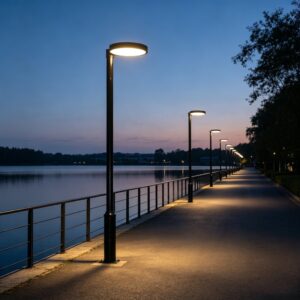
Solar streetlights have become an increasingly practical lighting solution for homes, businesses, farms, roads, parking areas, and other outdoor spaces in Kenya. They provide automatic lighting without monthly electricity bills, while modern LED technology and lithium batteries make solar lighting more efficient and reliable than many older outdoor lighting options.
However, choosing a solar streetlight is not simply about selecting the highest wattage. The way the light is controlled at night can have a major effect on battery consumption, illumination, security, and overall performance.
Two of the most common control systems are motion sensor solar streetlights and dusk-to-dawn solar streetlights. So, which one is better?
The answer depends on where the light will be installed, how frequently people or vehicles use the area at night, whether continuous illumination is required, and how much energy the solar system can store
What Is a Dusk-to-Dawn Solar Streetlight?
Before comparing the two technologies, understanding how each system works is paramount. This distinction helps you choose a solar streetlight based on the actual lighting requirements of your property rather than simply choosing a product because it has a particular sensor.
A dusk-to-dawn solar streetlight uses a light sensor, commonly called a photocell, to detect changes in ambient light.
During the day, the solar panel charges the battery while the LED light remains switched off. As daylight decreases in the evening, the sensor detects darkness and automatically switches the light on.
At dawn, increasing daylight triggers the light to switch off so the battery can begin charging again. This provides automatic operation without requiring someone to switch the light on and off manually.
Advantages of Dusk-to-Dawn Solar Streetlights
For areas where consistent nighttime lighting is important, this arrangement has several advantages:
- Automatic switching at sunset and sunrise
- Continuous illumination throughout the programmed nighttime period
- No manual operation
- Useful for security and general visibility
- Suitable for roads and areas with continuous nighttime activity
- Simple operating principle
A dusk-to-dawn solar streetlight can therefore be an excellent choice where the priority is reliable overnight illumination rather than maximum battery conservation.
Where Are Dusk-to-Dawn Solar Lights Best Used?
Understanding the application is one of the most important parts of solar lighting design. A light installed beside a rarely used farm entrance has very different requirements from one illuminating a busy commercial compound.
Dusk-to-dawn solar streetlights are particularly suitable for:
- Residential compounds
- Commercial premises
- Parking areas
- Hotels and guesthouses
- Schools
- Clinics
- Roads
- Business entrances
- Farm entrance
- Security perimeters
For public roads and other locations where lighting levels must be maintained consistently, the lighting design should follow the applicable local requirements rather than relying solely on motion activation.
What Is a Motion Sensor Solar Streetlight?
A motion sensor solar streetlight adds another layer of control. Instead of operating at full brightness throughout the entire night, the light can remain at a lower brightness level when the area is empty and increase its output when it detects movement.
Most systems use a PIR, or passive infrared, sensor to detect movement from people or vehicles. Some products use microwave sensing instead.
The important point is that a motion sensor does not necessarily mean the light switches completely off. Many modern systems use adaptive dimming: the light remains at reduced brightness and increases to a higher output when movement is detected. This approach is fundamentally an energy-management strategy.
Instead of using maximum battery power when nobody is present, the system reserves more energy for periods when illumination is actually needed.
How Does a Motion Sensor Solar Streetlight Save Energy?
The biggest advantage of a motion sensor solar streetlight is reduced average energy consumption.
Imagine a quiet compound where there may be no person or vehicle passing for several hours during the middle of the night. Keeping a powerful LED at 100% brightness throughout those hours consumes considerably more stored battery energy than operating at a reduced brightness level.
With motion-responsive lighting, the system can:
- Switch on automatically at dusk.
- Remain at a lower standby brightness.
- Detect a person or vehicle.
- Increase LED brightness.
- Remain bright while movement continues.
- Return to lower brightness after the area becomes quiet.
This type of control allows the solar panel and battery to work within a more manageable energy budget.
Technical guidance on solar street lighting similarly identifies sensors and dimming as ways to improve energy efficiency.
Motion Sensor vs. Dusk-to-Dawn Solar Streetlights
| Feature | Motion Sensor Solar Streetlight | Dusk-to-Dawn Solar Streetlight |
| Automatic operation | Yes | Yes |
| Detects darkness | Usually, when combined with a photocell | Yes |
| Detects movement | Yes | No |
| Continuous full brightness | Usually not | Yes, depending on the model |
| Energy conservation | Excellent | Moderate |
| Battery conservation | Excellent | Lower |
| Security response | Excellent | Good |
| Best for quiet areas | Yes | Yes |
| Best for busy roads | Depends on design | Yes |
| Ideal for continuous lighting | Less suitable | Excellent |
| Advanced control | Yes | Basic |
| Potential for longer nighttime runtime | Higher | Lower |
The key takeaway is that motion sensor solar streetlights prioritize energy efficiency, while dusk-to-dawn solar streetlights prioritize continuous illumination.
Which Solar Streetlight Uses Less Battery Power?
Battery capacity is one of the most important considerations when choosing a solar streetlight. The battery stores the energy generated during daylight and supplies the LED at night.
A full-brightness dusk-to-dawn system can consume substantially more energy than a properly configured motion-responsive system because the LED remains at high output even when nobody is using the area.
Motion sensor systems reduce this average load by dimming during inactive periods. Some commercial systems combine dusk-to-dawn control with PIR or microwave sensing specifically to extend battery runtime.
However, buyers should be careful with claims of a specific percentage of energy savings. Actual savings depend on:
- How frequently does movement occur
- Standby brightness
- Full-brightness level
- Sensor detection range
- Duration of each motion event
- Battery capacity
- LED efficiency
- Solar panel size
- Weather conditions
Therefore, motion sensing can reduce battery consumption, but the actual savings vary from installation to installation.
Which Is Better for Security?
Security lighting requires a slightly different way of thinking about illumination. The objective isn’t necessarily to have the brightest possible light throughout the night; it is to provide useful visibility when people, vehicles, or activity occur.
For compounds, gates, driveways,s and low-traffic areas, a motion sensor solar security light can be highly effective.
A person approaching a gate, for example, can trigger the light to increase from its standby level to full brightness. This sudden increase in illumination can improve visibility around the entrance while conserving battery power during periods when nobody is present.
For security-sensitive areas where constant visibility is important, however, completely dimming or switching off the light may not be appropriate. This is why hybrid systems are particularly useful.
Dusk-to-Dawn + Motion Sensor: The Best of Both Systems?
Modern solar streetlights increasingly combine both technologies instead of forcing buyers to choose one or the other.
A dusk-to-dawn solar streetlight with a motion sensor can use the photocell to establish when nighttime begins and ends, while the motion sensor controls brightness according to activity.
In practical terms:
- Daytime: Solar panel charges the battery,y and the LED remains off.
- Dusk: Photocell detects darkness and activates the light.
- Quiet period: The light operates at reduced brightness.
- Movement detected: PIR or microwave sensor triggers higher brightness.
- Area becomes quiet: The light returns to its lower-power setting.
- Dawn: The light switches off, and charging begins.
This combination gives the system automatic night operation while also reducing unnecessary energy consumption. Solar streetlight specifications used by the City of Kisumu demonstrate this type of combined approach, with automatic dusk-to-dawn switching and motion-triggered bright mode.
For many residential and commercial applications, this is arguably the most versatile configuration.
Which Is Better for Roads and Busy Areas?
This is where professional site assessment becomes particularly important. A solar streetlight should be selected according to the lighting requirement, not simply its marketing wattage.
On a road with frequent pedestrians and vehicles throughout the night, a motion sensor may be triggered frequently enough that the system spends much of the night at high brightness.
In such an environment, continuous dusk-to-dawn illumination may be more appropriate.
For quiet rural roads with occasional traffic, however, adaptive motion lighting can potentially reduce energy consumption while still providing high brightness when vehicles or pedestrians approach.
The U.S. Department of Energy notes that solar-powered street and area lighting is particularly suitable where lighting requirements are relatively low or intermittent and local solar availability can reliably recharge the battery.
This illustrates why site conditions should determine the lighting technology.
What Should You Check Before Buying a Solar Streetlight?
Choosing a solar streetlight based only on a number printed on the box can result in disappointing performance. Experienced installers look at the entire system.
LED Brightness
Don’t judge performance solely by watts. Look at the actual light output, beam distribution, and area the fitting is designed to illuminate.
Solar Panel
The panel needs to generate enough energy during daylight to replenish the battery after nighttime use.
Battery
Battery capacity determines how much energy can be stored. Battery chemistry, quality, and usable capacity also affect performance and lifespan.
Sensor Technology
Check whether the light has:
- Photocell/dusk-to-dawn sensor
- PIR motion sensor
- Microwave sensor
- Adjustable detection range
- Adjustable brightness settings
- Adjustable motion hold time
Weather Protection
Outdoor solar lighting is exposed to rain, dust, and temperature changes. Look for an appropriate IP rating and robust construction.
Installation Height and Coverage
A powerful light installed at the wrong height can produce poor illumination. Pole height, spacing, beam angle, and mounting position all affect the final result.
Cloudy-Weather Performance
A solar streetlight must be designed with local weather conditions in mind. A system that works perfectly after several sunny days may struggle if the panel and battery are undersized for prolonged cloudy conditions.
Motion Sensor vs. Dusk-to-Dawn: Which One Should You Choose?
The simplest way to make the decision is to start with the question: Do you need maximum brightness all night, or maximum efficiency during periods of low activity?
Choose a motion sensor solar streetlight when:
- The area is relatively quiet at night.
- You want to conserve battery power.
- Security is the main priority.
- The light is for a gate, driveway, or compound.
- Pedestrian or vehicle traffic is intermittent.
- You want the light to become brighter when activity is detected
Choose a dusk-to-dawn solar streetlight when:
- Continuous illumination is required.
- The road or area has regular nighttime activity.
- You need predictable overnight lighting.
- Security depends on maintaining consistent visibility.
- The lighting area should remain illuminated even when there is no movement.
For many applications, however, a solar streetlight with both dusk-to-dawn and motion sensor functionality provides the most flexible solution.
Final Verdict
There is no single winner in the motion sensor vs. dusk-to-dawn solar streetlights debate.
A dusk-to-dawn solar streetlight is the straightforward choice when continuous overnight illumination is the priority. It automatically switches on at night and off during the day, making it suitable for roads, compounds, businesses, and other areas requiring reliable illumination.
A motion sensor solar streetlight is better suited to areas where nighttime activity is intermittent. Reducing brightness during quiet periods and increasing it when people or vehicles are detected can make better use of stored solar energy.
For many modern installations, the strongest option is to combine both technologies: dusk-to-dawn control provides automatic nighttime operation, while motion sensing and dimming help conserve energy.
Ultimately, the best solar streetlight depends on your property’s size, lighting requirements, traffic level, security needs, available sunlight, and desired nighttime runtime. A properly sized system will always outperform a poorly selected high-wattage light.
Choose the Right Solar Streetlight from MK Homestyles
Whether you need solar street lights in Kenya for a residential compound, driveway, farm, business premises, parking area, gate, or security perimeter, choosing the right system is essential for dependable nighttime lighting.
At MK Homestyles, explore practical solar streetlights, motion-sensor solar lights, dusk-to-dawn solar streetlights, and solar security lighting for various outdoor applications. From energy-saving motion sensor models to high-power solar streetlights for larger areas, selecting the right combination of LED output, solar panel capacity, battery storage, and intelligent controls can give you reliable lighting without depending on grid electricity.
Choose the right solar streetlight for your space and make every night brighter, safer, and more energy efficient with MK Homestyles.