
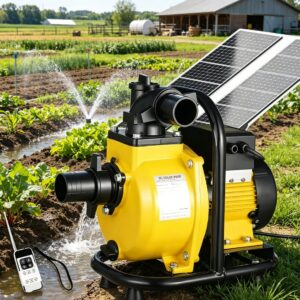
Choosing the right solar water pump is not simply a matter of selecting the pump with the highest horsepower or the largest advertised flow rate. The correct pump depends on where your water is located, how deep the water level is, how much water you need, how far the water must travel, and how high it needs to be lifted.
One of the most important decisions is whether to install a solar submersible pump or a solar surface pump. Both can be effective, but they are designed for very different pumping conditions.
For a homeowner drawing water from a shallow well, a surface pump may be practical and economical. For someone drawing groundwater from a deep borehole, a solar submersible pump is usually the more appropriate configuration. Farmers, homeowners and businesses in Kenya therefore need to understand the difference before investing in a solar water pumping system.
This guide explains the differences between a solar submersible pump vs surface pump, how each system works, their advantages and disadvantages, and how to choose the right solar pump for a borehole, well, tank or irrigation application.
What Is the Difference Between a Solar Submersible Pump and a Surface Pump?
Before comparing performance, it is important to understand the fundamental difference between the two pump designs. The position of the pump relative to the water source determines how the pump moves water and what type of installation it can handle.
A solar submersible pump is installed below the water level, usually inside a borehole or well. The pump pushes water upward through a delivery pipe.
A solar surface pump, on the other hand, remains above the water source. It draws water through a suction pipe and then pushes the water through the delivery system.
This difference sounds simple, but it has major implications for pumping depth, suction limitations, installation, maintenance and overall system performance.
How Does a Solar Submersible Water Pump Work?
Understanding how a solar submersible pump operates helps explain why it is particularly suitable for boreholes and deep water sources.
The pump and motor are installed underwater. Solar panels generate DC electricity, which is supplied directly to a suitable DC pump or through a controller/inverter to an AC pump.
When the system operates, the pump pushes water from the submerged position up through the rising main or delivery pipe.
Because the pump is already inside the water, it does not have to rely on the same suction arrangement as a surface pump. This makes the submersible configuration particularly useful where the water level is deep.
Solar submersible pumps are therefore commonly considered for:
– Boreholes
– Deep wells
– Deep groundwater sources
– Domestic water supply
– Livestock watering
– Agricultural irrigation
– Filling elevated storage tanks
– Remote locations without reliable grid electricity
Advantages of Solar Submersible Pumps
The main advantage of a solar submersible water pump is its ability to work with water sources where a surface pump would struggle.
Suitable for Deep Water Sources
If the water is located significantly below ground level, a submersible pump is generally a more suitable choice because it pushes water rather than relying on surface suction.
This is why solar borehole pumps are commonly designed as submersible systems.
Reduced Priming Problems
A surface suction pump needs to maintain a water-filled suction line and may need priming. On the other hand, a submerged pump does not have the same suction-line arrangement.
For solar applications, this can be particularly useful because solar irradiance changes throughout the day. Experts note that self-priming capability is important for surface suction pumps used with solar power because interruptions caused by changing solar conditions can otherwise create priming problems.
Efficient Borehole Operation
A properly selected submersible pump can efficiently move groundwater from a borehole to a storage tank or irrigation system.
Reduced Surface Noise
Because the motor and pump are underwater, the operating sound at ground level can be lower than that of a comparable surface-mounted pump.
Disadvantages of Solar Submersible Pumps
Although submersible pumps are excellent for deep water applications, they are not automatically the best choice for every installation.
Installation can be more involved because the pump has to be lowered into the well or borehole. Accessing the pump for maintenance may also require lifting it from the borehole.
The pump must also be correctly sized for the borehole diameter, water level, required flow and total dynamic head.
Another important consideration is dry running. A pump should not be allowed to operate without sufficient water because inadequate cooling and lubrication conditions can damage certain pump designs. Proper systems may therefore use water-level sensors, probes, float switches or controller protection.
How Does a Solar Surface Pump Work?
A solar surface pump is installed above the water source. It draws water through a suction pipe and then delivers it through the discharge pipe.
Surface pumps are commonly used where the water source is relatively shallow and easily accessible.
Typical applications include:
– Shallow wells
– Water tanks
– Rivers
– Dams
– Ponds
– Rainwater storage
– Open reservoirs
– Water transfer between tanks
– Certain irrigation applications
However, the critical issue with a surface pump is suction lift.
What Is Suction Lift?
Suction lift is the vertical distance between the water surface and the pump inlet.
This is different from the total delivery height. A surface pump must first draw water from the source and then push it to its destination.
As suction lift increases, the practical limitations of the pumping system become more important. This is why a surface pump should not be selected simply because its product description claims a particular maximum head.
You need to distinguish between:
Suction lift: how far the pump must draw water upward.
Delivery head: how high the pump must push water.
Friction losses: resistance caused by pipes, bends, valves and fittings.
Total dynamic head: the overall head that the pump must overcome while delivering the required flow.
This distinction is one of the most important technical considerations when choosing a solar water pump for a home, farm or borehole.
Advantages of Solar Surface Pumps
A solar surface pump can be an excellent option when the water source is shallow and accessible.
Easier Maintenance
Because the pump is installed above ground, technicians can generally inspect and service it more easily than a submerged pump.
Convenient for Water Transfer
Surface pumps can be useful for moving water from one tank to another, drawing from reservoirs or supplying irrigation systems from accessible water sources.
Easy Visual Inspection
Leaks, unusual sounds and other problems can often be identified without removing the pump from a borehole.
Suitable for Shallow Water Sources
Where the water level is relatively close to the pump, and the suction requirements are within the pump’s capabilities, a surface pump can be a practical solution.
Disadvantages of Solar Surface Pumps
The major limitation for solar surface pumps is suction.
A surface pump cannot simply be installed anywhere and expected to draw water from any depth. The actual achievable suction depends on atmospheric pressure, water temperature, pipe configuration, pump design, elevation and other operating conditions.
This is why claims such as “maximum suction” should be interpreted carefully rather than treated as a guarantee of real-world performance.
Surface pumps can also lose their prime if air enters the suction pipe or the water level changes significantly.
For solar installations, intermittent power caused by changing sunlight can make these issues more noticeable.
Solar Submersible Pump vs Surface Pump: Key Differences
Here is the information organized into a clean comparison table:
| Feature | Solar Submersible Pump | Solar Surface Pump |
| Pump location | Underwater | Above ground |
| Best suited to | Boreholes and deep wells | Shallow wells and open water |
| Suction limitation | Minimal suction arrangement | Important consideration |
| Maintenance access | More difficult | Easier |
| Borehole application | Excellent | Usually unsuitable for deep sources |
| Tank-to-tank transfer | Possible but often unnecessary | Excellent |
| Open reservoir pumping | Possible with appropriate configuration | Common application |
| Priming concerns | Generally lower | More important |
| Noise at the surface | Generally lower | More noticeable |
| Installation | More involved | Simpler in many applications |
| Deep groundwater | Preferred | Limited |
| Shallow water | Can work | Often practical |
The table demonstrates why there is no universally “best solar water pump.” The best pump matches the water source and hydraulic requirements.
Which Pump Is Better for a Borehole?
For most deep-borehole water pumping applications, a properly selected solar submersible pump is the logical starting point.
The pump is installed below the water level and pushes water toward the surface. This avoids relying on a long suction lift.
Borehole installations should, however, be professionally assessed before purchasing a pump.
Important information includes:
– Borehole depth
– Static water level
– Dynamic water level
– Borehole diameter
– Borehole yield
– Required daily water volume
– Required flow rate
– Elevation of the storage tank
– Pipe length
– Pipe diameter
– Friction losses
– Solar resource
– Required pumping hours
A 100 metres deep borehole does not necessarily require a pump capable of lifting water through 100 metres of head. What matters is the actual water level and the complete hydraulic system.
Conversely, a shallow borehole may still require a relatively powerful pump if the water has to be delivered a considerable vertical distance or through a long pipeline.
Which Pump Is Better for a Shallow Well?
For a shallow well, a solar surface pump can be an economical option if the suction requirement is within the pump’s practical operating range.
The water source should be stable, the suction pipe should be properly installed and airtight, and the pump should be correctly primed where required.
A submersible pump can also be used in shallow wells, so the decision should consider reliability, installation cost, maintenance preferences and the required flow.
The key point is that shallow water does not automatically mean “surface pump.” The entire system still needs to be assessed.
Solar Submersible Pump vs Surface Pump for Irrigation
Agricultural irrigation introduces another layer of complexity because farmers often require substantial volumes of water rather than simply high pressure.
A solar irrigation system should therefore be designed around water demand, flow, head and available solar energy.
You should consider sizing resources, water requirements, discharge, head losses and pump selection as interconnected parts of system design.
For example, a farmer may have a shallow river next to a farm. A surface pump could be appropriate because the water source is accessible.
Another farmer may irrigate from a deep borehole. A submersible solar pump would generally be more appropriate.
The right choice is therefore determined by the water source and hydraulic requirements rather than the word “solar” on the product label.
How Do You Choose the Right Solar Water Pump?
Choosing the right solar water pump in Kenya begins with understanding how much water you need and where that water has to go.
1. Determine Your Required Flow Rate
Flow rate describes how quickly water must be delivered.
It may be expressed in:
– Litres per minute
– Litres per hour
– Cubic metres per hour
– Cubic metres per day
A domestic system supplying a storage tank may have a different requirement from a commercial irrigation system.
Do not select a pump based solely on its maximum flow figure. Maximum flow is normally achieved under particular head conditions and may fall significantly when the pump is required to lift water higher.
2. Calculate Total Dynamic Head
Head is one of the most important concepts in pump selection.
It represents the resistance the pump must overcome to move water through the system.
Total dynamic head can include:
– Vertical elevation
– Water-level changes
– Pipe friction
– Elbows
– Valves
– Filters
– Fittings
– Pressure requirements at the destination
The Food and Agricultural Organization of the United Nations identifies the relationship between flow, head and power as fundamental to solar pumping design.
This is why two properties with identical borehole depths may require completely different pumps.
3. Check the Pump Curve
A professional pump selection should consider the pump’s head-flow curve.
For example, a pump advertised as capable of delivering a high number of litres per minute may only achieve that figure at low head.
At a higher head, the actual flow may be much lower. Therefore, always ask:
“What flow will this pump deliver at my required total dynamic head?”
That question is far more useful than simply asking:
“How many litres per minute is the pump?”
4. Match the Solar Panels to the Pump
A solar pump needs a properly matched photovoltaic array and controller.
The solar panels must provide adequate electrical power under realistic operating conditions. Solar radiation changes throughout the day because of cloud cover, temperature, sun angle and other environmental factors.
Professional solar pumping design, therefore, considers both the pump’s electrical requirements and the solar resource available at the installation site.
Research and technical guidance on photovoltaic water pumping emphasise the importance of matching pump requirements with available solar irradiation and system demand.
Do Solar Submersible Pumps Use More Electricity Than Surface Pumps?
This question is more complicated than simply comparing the wattage printed on two pump labels.
Energy consumption depends on the amount of water moved, the required head, pump efficiency, motor efficiency, controller performance and operating conditions.
A smaller pump that struggles against a high head may perform worse for a particular application than a properly sized pump with a higher rated power.
Similarly, a larger pump is not automatically better. Oversizing can increase the cost of the solar array and pumping equipment without providing useful additional water.
The objective should be to achieve the required flow at the required head with an appropriately sized solar power system.
What Happens When Solar Radiation Changes?
Solar water pumping is directly affected by available solar energy.
On a bright sunny day, the photovoltaic array can provide stronger power to the pump. Under cloudy conditions, available power may fall.
This does not necessarily mean that the system stops completely. Depending on the pump, controller and system design, output may simply decrease.
This is why water storage is an important part of many solar pumping installations.
Instead of trying to run the pump at maximum output whenever water is needed, the system can pump water into a storage tank during available sunlight and use the stored water later.
For domestic water supply and irrigation, properly sized storage can therefore improve the practical reliability of a solar pumping system.
Solar Water Pump for Home, Farm or Borehole: Which One Should You Choose?
The application should always determine the pump configuration.
For a deep borehole
Choose a solar submersible pump that is correctly sized for the borehole, water level, required flow and total dynamic head.
For a shallow well
A solar surface pump may be appropriate if the suction conditions are within the pump’s practical limits.
For a river or pond
A surface pump is often convenient because the water source is directly accessible.
For filling a water tank from another tank
A surface pump may be a practical option, provided the pump is correctly sized for the required flow and head.
For agricultural irrigation from a deep borehole
A solar submersible pump is commonly the more suitable configuration.
For livestock watering
Either configuration can work depending on the source, depth and water demand.
Common Mistakes When Buying a Solar Water Pump
Many pump problems are caused not by poor pump quality but by incorrect system sizing.
One common mistake is buying a pump based only on horsepower. Another is ignoring the total dynamic head.
Some buyers also compare pumps using maximum flow rates without checking what flow the pump delivers at their actual operating head.
Other mistakes include:
– Choosing an undersized solar array
– Ignoring borehole yield
– Using undersized pipes
– Failing to account for friction losses
– Installing a surface pump beyond its practical suction capability
– Ignoring water-level changes
– Running a pump dry
– Selecting the wrong controller
– Failing to install appropriate water-level protection
Technical assessment before purchase can prevent expensive equipment failures and disappointing water output.
Frequently Asked Questions About Solar Submersible and Surface Pumps
1. Is a solar submersible pump better than a surface pump?
Neither is universally better. A submersible pump is generally more suitable for deep boreholes and wells, while a surface pump can be advantageous for shallow sources, tanks and accessible surface water.
2. Can a surface pump be used for a borehole?
It may be possible for a very shallow water level, but surface suction has practical limitations. Deep boreholes are generally better served by a properly selected submersible pump.
3. Which solar pump is best for a deep borehole?
A solar submersible borehole pump is generally the appropriate configuration. The exact pump must be selected according to the borehole’s water level, required flow, head, diameter and yield.
4. Which pump is best for irrigation?
It depends on the water source. A surface pump may be suitable for a river, pond or shallow source, while a submersible pump is generally more suitable for deep groundwater.
5. How do I know what size solar pump I need?
Determine the required daily water volume, flow rate, pumping depth, total dynamic head and available solar resource. Pump and solar-panel sizing should then be matched to those requirements.
Solar Submersible Pump vs Surface Pump: Final Verdict
The solar submersible pump vs surface pump debate does not have one universal winner. The right choice depends on the water source and the hydraulic conditions.
If you are pumping from a deep borehole or well, a properly sized solar submersible pump will usually be the more appropriate solution because it operates below the water level and pushes water to the surface.
If you are drawing from a shallow well, river, pond, reservoir or tank, a solar surface pump can provide a practical and easily accessible solution.
The most important lesson is to avoid choosing a pump based solely on horsepower, price or advertised maximum flow. A reliable solar water pumping system must be designed around flow, total dynamic head, water demand, pump performance, solar power availability and the characteristics of the water source.
Get the Right Solar Water Pump from MK Homestyles
Choosing between a solar submersible pump and a solar surface pump becomes much easier when you understand your water source and pumping requirements. At MK Homestyles, we provide reliable energy and water-pumping solutions for Kenyan homes, farms, businesses and other applications. Whether you need a solar borehole pump, solar submersible water pump, solar surface pump, solar irrigation pump or complete solar water pumping system, choosing the correct equipment is essential for reliable water delivery and long-term performance.
If you are searching for solar water pumps in Kenya, solar submersible pumps in Kenya, solar surface pumps, solar borehole pumps, solar irrigation pumps or reliable water pumps in Nairobi, MK Homestyles can help you identify a solution suited to your actual pumping requirements. Contact MK Homestyles for dependable solar water pumping solutions in Kenya, quality solar equipment and practical advice on selecting the right pump for your borehole, well, farm, tank or domestic water supply.