
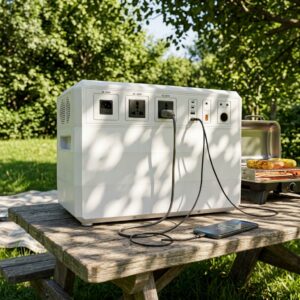
A 2000W portable power station can be an excellent solution for keeping essential appliances running during power outages, for working remotely, for camping, or for operating equipment in areas without reliable electricity. Depending on its battery capacity and inverter specifications, it can power devices such as televisions, laptops, Wi-Fi routers, LED lights, fans, and many refrigerators. Some models can also operate selected kitchen appliances and water pumps.
However, choosing the right portable power station involves more than looking at the wattage printed on the product. You need to understand the difference between power output and battery capacity, calculate your total appliance load, and account for the extra power appliances require at startup.
At MK Homestyles Kenya, we help customers understand these specifications so they can choose practical, reliable backup power solutions for their homes, offices, shops, and outdoor activities. This guide explains what a 2000W portable power station can run, how long it may last, and what to consider before buying one.
What Does 2000W Mean on a Portable Power Station?
Before deciding which appliances to connect, it is important to understand what the 2000W rating actually represents. This specification tells you how much electrical power the inverter can deliver at a given moment, subject to the manufacturer’s continuous output rating.
A 2000W portable power station rated for 2000W continuous output can theoretically operate appliances drawing up to 2000 watts in total. For example, a 100W television, a 60W laptop, a 50W fan, and 40W of LED lighting would use approximately 250W together.
That leaves substantial output capacity for other compatible devices. However, the total load must remain within the station’s limits, and appliances with motors or compressors may require additional starting power.
Understanding watts versus watt-hours
Two specifications are particularly important when comparing portable power stations:
Watts (W): The power the station can supply at one time.
Watt-hours (Wh): The amount of energy stored in its battery, which helps determine how long appliances can run.
For instance, a 2000W power station with a 1000Wh battery has a different runtime from a 2000W model with a 2048Wh battery, even though both may have the same continuous output rating. Always check both figures before purchasing.
What Appliances Can a 2000W Portable Power Station Run?
For most households, the biggest advantage of a 2000W portable power station is the ability to power several everyday essentials without running a fuel generator. The exact combination depends on each appliance’s wattage and whether it requires extra power when switched on.
The following table provides indicative running-wattage ranges for common appliances. Actual figures vary by model, size, operating mode, and manufacturer.
Appliances, a 2000W Portable Power Station, Can Run
| Appliance | Typical Running Power | Can a 2000W Power Station Run It? |
| LED lights | 5–15W each | Yes |
| Wi-Fi router | 10–30W | Yes |
| Smartphone charging | 5–25W | Yes |
| Laptop | 45–100W | Yes |
| Television | 50–200W | Yes |
| Standing fan | 40–100W | Yes |
| Desktop computer | 100–300W | Usually |
| Refrigerator | 60–250W while running | Usually, if the startup surge is supported |
| Microwave | 800–1,500W input | Often, check the appliance label |
| Electric kettle | 1,500–2,200W | Only if its actual power draw is within the station’s rating |
| Washing machine | Varies considerably | Model-dependent |
| Water pump | Varies by motor size | Check both running and starting power |
Important note: A 2000W power station can supply appliances with a combined running load of up to 2000W, provided its continuous output rating supports that load. Appliances with motors or heating elements may require additional starting or peak power. Also, the station’s battery capacity, measured in watt-hours (Wh), determines how long the appliances can run.
Running household electronics during a blackout
A 2000W portable power station is well-suited to keeping essential electronics operational during short power interruptions. A household could run a television, Wi-Fi router, laptop, several LED lights, and phone chargers simultaneously, provided their combined consumption and startup demands stay within the inverter’s limits.
This makes a portable power station useful for home offices, small businesses, online meetings, CCTV equipment, and basic evening lighting. For households that depend on internet access for work or school, keeping the router and communication devices powered can be just as important as keeping the lights on.
Can a 2000W Power Station Run a Fridge, TV and Wi-Fi Router Together?
Refrigerators are among the most useful appliances to support during a power outage because they help protect food and reduce unnecessary spoilage. A 2000W portable power station can run many domestic refrigerators, but the compressor’s startup demand must be considered.
A refrigerator drawing 150W while its compressor is running, combined with a 100W television, a 20W router, and 30W of lighting, creates a running load of approximately 300W. This is comfortably below a 2000W continuous output limit.
However, the refrigerator may briefly draw considerably more power when the compressor starts. If the surge exceeds the power station’s peak rating, the inverter may shut down even when the average load is low.
For reliable performance, check the refrigerator’s startup requirements and the power station’s specified surge capability. Also, remember that a refrigerator cycles on and off, so its average energy consumption over several hours is more useful for estimating battery life than its running wattage alone.
Can a 2000W Portable Power Station Run Kitchen Appliances?
Kitchen appliances require special attention because heating elements consume a substantial amount of electricity. A kettle, microwave, air fryer, or induction cooker may operate within a 2000W output limit, but the available battery energy can be depleted quickly.
For example, a 1500W kettle may operate on a suitable 2000W station. However, a 2000W-rated inverter does not guarantee that every kettle will work, especially if the kettle draws more power than expected or if other appliances are running simultaneously.
A practical approach is to use high-power kitchen appliances individually rather than switching on several at once. A kettle drawing 1500W alongside a 200W microwave and 150W of other loads would bring the total to 1850W, leaving little room for unexpected demand.
Technician’s advice: Avoid assuming that an appliance is compatible just because its running wattage appears to fit. Check the station’s continuous output, surge rating, output voltage, and the appliance’s input power before connecting it.
How Long Can a 2000W Portable Power Station Run Different Appliances?
Knowing which appliances a power station can operate is only half the decision. You also need to estimate how long the battery can sustain them, particularly if you expect a long blackout or need overnight backup.
Runtime depends primarily on the battery’s watt-hour capacity and the average load. Inverter losses and the battery’s usable capacity reduce the energy available to appliances.
A useful estimate is:
\\text{Runtime (hours)} \\approx
\\frac{\\text{Battery capacity (Wh)} \\times 0.85}
{\\text{Average load (W)}}
The 0.85 factor assumes approximately 85% of the rated battery energy is delivered to the appliances. Actual efficiency varies by model and operating conditions.
The following examples assume a 2000Wh battery, which is not automatically included in every 2000W power station.
Estimated Runtime of a Portable Power Station at Different Loads
| Average Load | Estimated Runtime |
| 20W | 85 hours |
| 50W | 34 hours |
| 100W | 17 hours |
| 200W | 8.5 hours |
| 500W | 3.4 hours |
| 1,000W | 1.7 hours |
| 1,500W | 1.1 hours |
| 2,000W | 51 minutes |
Note: These are estimated runtimes. Actual performance depends on battery capacity, inverter efficiency, fluctuations in power consumption, and the power station’s usable battery capacity.
What do these runtime estimates mean in practice?
If you use the power station mainly for a router, laptop, LED lighting, and phone charging, the battery may last considerably longer than when running a kettle or other heating appliance. A sustained 1000W load consumes stored energy ten times faster than a 100W load.
Refrigerators need a separate consideration because their compressors cycle. A refrigerator drawing 150W when running will not necessarily consume 150W continuously throughout the day. Ambient temperature, door openings, thermostat settings, and compressor efficiency all influence total consumption.
For a more accurate estimate, measure the appliance’s energy use over several hours using a suitable energy meter. This is especially useful when planning backup for refrigeration, business equipment, or other essential loads.
What Is the Difference Between a 2000W and a 2000Wh Power Station?
When comparing portable power stations in Kenya, this distinction can prevent an expensive purchasing mistake. The two figures describe different aspects of performance.
A 2000W output rating describes how much power the inverter can supply at once. A 2000 Wh capacity indicates how much energy the battery stores.
For example, two power stations may both deliver 2000W continuously, but one could have a 1024Wh battery while the other has a 2048Wh battery. The second model would generally offer approximately twice the battery energy under comparable conditions, although actual runtime depends on efficiency and load.
Likewise, a product marketed as a “2000” power station may not actually have 2000W of output. Confirm the manufacturer’s specifications instead of relying on the product name alone.
Can You Recharge a 2000W Portable Power Station Using Solar Panels?
For customers seeking portable power backup in Kenya, solar charging can make a power station more useful during prolonged outages or when travelling off-grid. Many portable power stations support solar charging, but the available input power and compatibility vary by model.
Before buying solar panels, check the station’s maximum solar input wattage, permitted input voltage range, connector type, and charging requirements. The panels must operate within the manufacturer’s limits; connecting an incompatible panel arrangement can prevent charging or damage equipment.
Actual charging time depends on sunlight, panel orientation, shading, temperature, and the power station’s charging limits. A panel advertised as 400W will not necessarily deliver 400W continuously throughout the day.
A solar-compatible 2000W portable power station can be particularly useful for camping, remote work, small shops, and essential home backup. For longer outages, solar recharge can help replenish the battery during the day, while appliances draw on stored energy as needed.
At MK Homestyles Solar Solutions, choose equipment based on your actual energy needs and verify that the power station and solar panels are compatible before purchasing.
What Appliances Should You Avoid Running on a 2000W Power Station?
Although a 2000W portable power station can support many everyday appliances, it is not automatically a replacement for a whole-house backup system. Certain devices can exceed their output capacity or drain the battery too quickly to be practical.
Be particularly careful with:
Electric heaters: These can draw 1500–2500W or more, leaving little usable battery time.
Large electric cookers: Some models exceed 2000W and require a higher-output system.
Air conditioners: Compressor startup demand and sustained consumption must be checked.
Large water pumps: Motor starting current can be significantly higher than normal running current.
Multiple high-power appliances: Their combined wattage may exceed the inverter rating.
Never exceed the manufacturer’s continuous output or surge limits. If you need to operate several heavy appliances or provide backup power for an entire home, consider a larger power station or a properly sized inverter-and-battery system.
How to Choose the Best 2000W Portable Power Station in Kenya
Choosing the right model requires balancing battery capacity, inverter performance, charging flexibility, portability, and long-term reliability. A good purchasing decision starts with identifying the appliances you need to keep running during an outage.
Use this checklist before buying:
- Check continuous output: Confirm that the station can handle your combined appliance load.
- Compare battery capacity: Look at Wh, not just the 2000W rating.
- Verify surge capacity: Essential for refrigerators, pumps, and other motor-driven appliances.
- Check charging options: Consider mains electricity, solar input, and any supported vehicle charging.
- Review battery technology: LiFePO4 batteries are worth considering for frequent cycling and long service life, subject to the manufacturer’s specifications.
- Confirm output compatibility: Check that the voltage, frequency, sockets, and waveform suit your appliances.
- Review warranty and support: Buy from a supplier that can explain the specifications and help with product selection.
Frequently Asked Questions
1. Can a 2000W power station run a fridge overnight?
Yes, many models can run a compatible refrigerator overnight, but the outcome depends on battery capacity, the refrigerator’s average energy consumption, and the compressor’s startup requirements.
2. Can a 2000W power station run a washing machine?
Some washing machines may operate within the output limit, but heating cycles, motor demand, and startup surges can increase consumption. Check the appliance’s maximum input rating and the station’s specifications first.
3. Is a 2000W portable power station enough for a Kenyan home?
It can be sufficient for essential appliances such as lights, a TV, a router, laptops, and some refrigerators. Running an entire household, especially with electric cooking and heating appliances, may require a larger system.
4. Can a 2000W power station run a water pump?
Possibly. You must check the pump’s running wattage, startup surge, and voltage compatibility. Some pumps require substantially more starting power than their normal operating wattage.
5. How long will a 2000W power station last?
Its service life depends on battery chemistry, usage, charging practices, temperature, and maintenance. Runtime per charge depends on battery capacity in Wh and the connected load in watts.
Get the Right Portable Power Station from MK Homestyles Kenya
A 2000W portable power station can provide dependable backup electricity for essential household appliances, small offices, and outdoor activities. The key is to match its continuous output, surge rating, and battery capacity to your actual needs instead of relying on wattage alone.
At MK Homestyles Kenya, we offer practical guidance on portable power stations, solar products, and reliable backup power solutions. Whether you are looking for a portable power station for home backup, a solar-compatible power supply, or dependable MK Homestyles power solutions for your business, start by identifying the appliances you need to operate and how many hours of backup you require.
Explore MK Homestyles for portable power stations and solar solutions, or contact our team for help choosing the right system for your requirements.
MK Homestyles Kenya — reliable electrical, solar, and power backup solutions for your home and business.